






Archives
August 2026
Electrolytic-plasma nitriding of austenitic stainless steels after mechanical surface treatment
In this work, the effect of preliminary mechanical surface treatment on the kinetics of formation, phase composition, and functional properties of the nitrided layer during electrolytic-plasma nitriding (EPN) of austenitic stainless steel 12Kh18N10T (AISI 321) was investigated. In contrast to traditional approaches, for the first time, this work establishes a direct correlation between the degree […]
Transforming aging forging presses into high-performance assets
Demand for new or modernized forging equipment is rising globally as requirements surge for the forged parts needed to replace depleted stockpiles of items such as artillery shells, tanks, aircraft parts, and other military equipment. According to the Forging Industry Association, “Forged components are found in virtually every defense implement, from rifle triggers to nuclear […]
July 2026
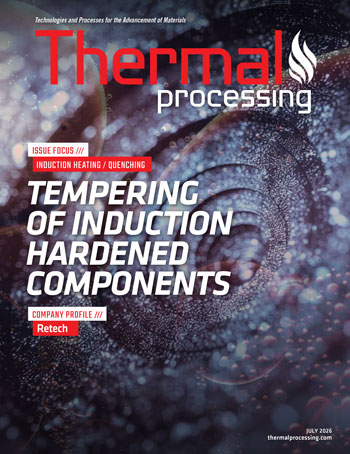
Tempering of induction hardened components
Tempering is a subcritical heat-treatment process used to reduce brittleness in case-hardened parts. Tempering is normally done between 280°F/138°C and 450°F/232°C, and 350°F/177°C is probably the most widely used temperature. The time is usually about 1 hour or more at temperature. “Untempered martensite is not fit for service.” This is undoubtedly something every materials or […]
Finite element modeling of the carburizing-quenching process in steels
Carburizing-quenching is a thermochemical surface treatment designed to harden the surface of steels and make them more resistant to friction, wear, and corrosion. It involves the diffusion of carbon atoms at high temperature, followed by rapid cooling to induce a phase transformation from austenite to martensite. This process therefore combines a diffusion process, possibly assisted […]
June 2026
Enhancing the Performance of Metal AM Parts
Material extrusion for metals (MEX/M) has emerged as a cost-effective and versatile additive manufacturing technology (AM) for producing complex metal components. Despite its potential, parts realized via MEX/M suffer from significant limitations, primarily poor surface quality due to the intrinsic layer-wise effect from the printing deposition and selected printing conditions. Furthermore, the multi-step nature of […]
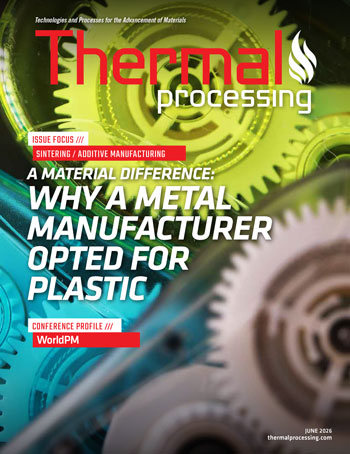
A Material Difference: Why a metal manufacturer opted for plastic in cooling tower upgrade
In powder metallurgy, material selection is everything. Choosing the right alloy determines whether a component will deliver reliable and long-term performance under intense environmental conditions such as high heat, extreme pressure, or excessive wear. A miscalculation can result in increased maintenance needs, premature failures, and costly downtime for end users. The same principle applies to […]
May 2026
Execution standards for on-site direct gas fire PWHT on large pressure vessels
Post weld heat treatment on large pressure vessels is not a simple operation. When a vessel weighs hundreds of thousands of pounds, spans 70 to 100 feet in length, and carries a wall thickness measured in inches rather than fractions, every decision made during setup and execution has consequences. Do it right and you relieve […]
Heat-treatment effects on the properties of TI made with cold spraying additive manufacturing
Cold spraying additive manufacturing (CSAM) Ti exhibits minimal plasticity, posing a significant challenge to its broader application. Heat treatment is recognized as a potent strategy to enhance the mechanical properties of additive manufacturing parts. However, prior investigations have struggled to discern the genuine impact of heat treatment on CSAM Ti due to the high porosity […]
April 2026
Heat treatments for sprayed lead-free piezoelectric ceramic coatings
The piezoelectric ceramic coating, [0.94(Bi0.5Na0.5)TiO3-0.06BaTiO3]0.98-(LiNbO3)0.02 (BNBTLN), was fabricated by thermal spray process on stainless steel substrates with thermal barrier coating (TBC) as an intermediary layer. The morphology, structure, and electrical properties of the thermal-sprayed BNBTLN coatings after furnace heat treatment (F-HT) and plasma torch heat treatment (P-HT) were studied, respectively. The BNBTLN coatings after F-HT […]
The Foundation of reliable Gas Ignition
Silicon carbide hot surface ignition has been used in gas-powered equipment for decades because it delivers consistent ignition in environments defined by heat, thermal cycling, and combustion byproducts. In appliance applications — where ignition must be repeatable, safe, and manufacturable at scale — silicon carbide remains the baseline material against which other igniter technologies are […]
March 2026
Simulation-based prediction of the thermal process emission measured by pyrometry of 316L stainless steel
Laser powder bed fusion is a common additive manufacturing process in which metal powder is selectively melted by a laser. Meandering stripe hatching is often used in conjunction with constant process parameters such as laser power and scan speed. However, the exposure strategy and the part geometry influence the resulting melt pool. To compensate for […]
Effect of various heat-treatment methods on AISI 4140 steel
AISI 4140 steel is one of the important categories in the steels with a wide range of applications including but not limited to automotive, general machinery, and the oil and gas industry. In the current study, an effort is made to understand the effects of heat-treatment parameters, such as heat-treatment temperature and holding time, on […]
February 2026
Efficiency and evolution: How modern burners are redefining industrial combustion
Industrial combustion systems remain at the heart of process heating across manufacturing, energy generation, and infrastructure. As energy prices fluctuate and environmental standards tighten, burner technology has quietly evolved into a high-precision field where control, safety, and sustainability must coexist. In the U.K. and across Europe, companies such as Dunphy Combustion have spent decades refining […]
High temp insulation: Versatile and efficient ceramic fiber solution
High-temperature insulation is a critical component in industrial thermal processing, maximizing efficiency, reducing energy costs, and extending equipment lifespan. As industries seek increasingly effective solutions, the demand for specialized thermal insulation is growing rapidly. This article will explore the benefits of high-temperature insulation, focusing on ceramic fiber products. It will analyze their properties, key applications, […]
January 2026

The effects of deep cryogenic treatment on M2 high speed steel
Deep cryogenic treatment has been reported to be a beneficial process for improving the properties and microstructure of steels. Generally, deep cryogenic treatment should be combined with tempering to achieve the optimal effects on steels. However, the microscale relationship between deep cryogenic treatment and subsequent tempering is unclear. Therefore, the effects of deep cryogenic treatment […]
Preventing discoloration in vacuum heat treatment: Guidelines for contamination control
Discoloration in vacuum heat treatment can indicate contamination, leading to potential product quality issues and process inefficiencies. Even minor contamination can compromise part integrity, causing oxidation, residue buildup, and surface defects. This article explores the key sources of contamination in vacuum furnaces, including outgassing, backstreaming, leaks, and particle generation. Learn how to identify, evaluate, and […]