









In my last article, a description of the physical metallurgy of beryllium-copper alloys was provided. In this article, we are going to discuss the heat treatment of these alloys.
Introduction
Cu–Be alloys typically contain 0.2–2 wt.% Be with minor additions (e.g. Co, Ni). These alloys are designed so that Be exhibits appreciable solid solubility in copper at high temperature but very limited solubility at ambient temperature. This is the classic precipitation‑hardening system: solution treatment produces a supersaturated solid solution, and controlled aging drives precipitation of Be‑rich phases that impede dislocation motion[1].
Beryllium-copper alloys harden in a similar fashion to aluminum alloys. After quenching, a supersaturated copper solid solution matrix occurs. Initially, during aging, there is clustering of the Be atoms in the copper matrix. These very fine clusters form Guinier-Preston zones on {100} matrix planes [2] [3]. The GP zones act as precursors to later coherent precipitates that provide strengthening, and eventually the incoherent equilibrium precipitate.
The basic precipitation mechanism is supersaturated alpha-Cu after quench, GP clustering on {100}, metastable gamma double-prime, metastable gamma prime, then stable gamma equilibrium precipitate (Equation 1):

As in aluminum alloys, strengthening occurs before the formation of the equilibrium precipitate, and the onset of coarsening.
Solution Heat Treatment
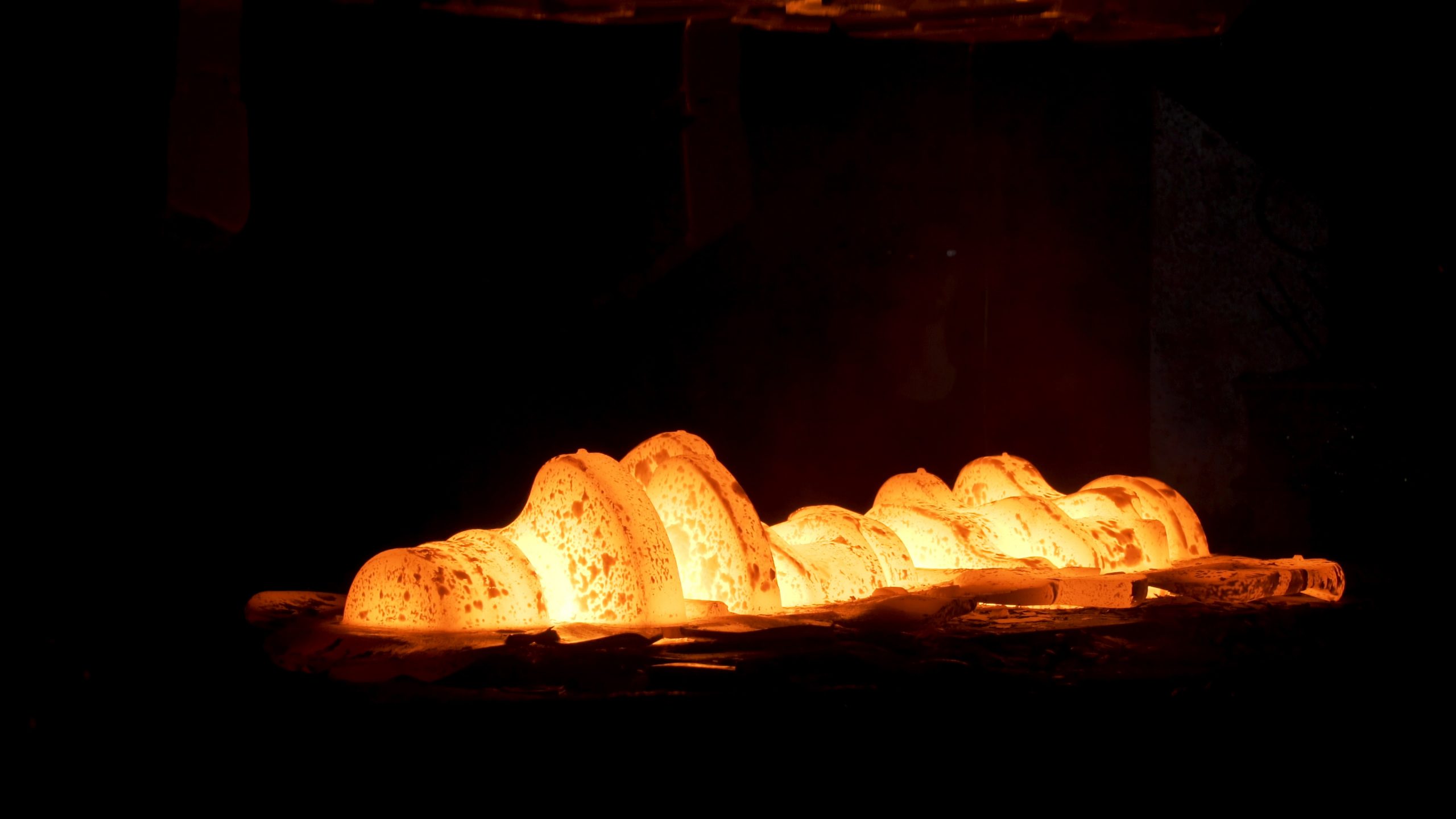
Solution heat treatment of Be-Cu alloys consists of heating into the single-phase α region on the phase diagram [4]. At solution, heat treatment temperatures are on the order of 760–800°C for high‑strength grades and 900–955°C for high‑conductivity grades. At these temperatures, the Be‑rich equilibrium phase is fully dissolved into the Cu matrix [4] [2] [3].
The alloy is held at temperature long enough to dissolve the Be-rich phases and homogenize the microstructure, without causing excessive grain growth. The soaking time is usually on the order of one hour per inch of section thickness, which is adequate to achieve temperature uniformity and homogeneous solute distribution through the part.
The furnace atmosphere of Be-Cu alloys must be controlled because these alloys form an adherent oxide film. For most applications, the surface quality is important, so solution heat treatment is usually accomplished using a protective atmosphere, or in a vacuum furnace. Atmospheres used are typically dry nitrogen or nitrogen-hydrogen mixtures. Heating rates are also important.
Excessively slow heating through the recrystallization range can promote non-uniform grain growth, especially if cold-worked prior to heat treatment [1] [4].
Quenching
The purpose of quenching after solution treatment is to suppress Be‑rich precipitation during cooling and retain a supersaturated solid solution. To achieve this, cooling must be sufficiently rapid through the critical temperature range where precipitation kinetics are significant, typically a few hundred degrees below the solution heat-treatment temperature, like aluminum alloys [5]. For the most part, water is used as the primary quenchant, however, polymer quenchants or oil quenchants have also been used, if they achieve the necessary supersaturation. Some patents have explored the use of molten salts to control distortion [6]. However, water is the preferred quenchant.
Quenching is a balance, with slow cooling rates resulting in partial precipitation during the quench, with a reduction in subsequent age‑hardening response. On the other hand, extremely severe quenching can cause distortion, residual stress, and quench cracking.
For the most part, quenching is accomplished by immersion in agitated quench tanks. However, for strip, rod, or small parts, spray quenching is used to provide controlled and uniform cooling.
Artificial Aging
Aging of Be–Cu is conventionally carried out at temperatures in the range 260–400°C for high‑strength grades and 425–565°C for high‑conductivity electrode grades, with holding times from a few tenths of an hour up to several hours depending on section thickness and required properties. A common industrial treatment for a high‑strength alloy comparable to C17200 is aging at around 300–320°C for two to four hours, which yields tensile strengths on the order of 1,100–1,200 MPa and hardness values near HRC 38–42 [4] [2] [3] [1].
Below about 260°C, precipitation occurs but kinetics are slow, leading to long aging times and limited industrial practicality. Above roughly 320–340°C, precipitation is too rapid and coarsening becomes dominant, often resulting in reduced peak strength and a narrower process window. Aging curves typically show a pronounced hardness peak at intermediate times followed by over-aging, in which strength decreases, and ductility and conductivity increase as precipitates coarsen and the matrix solute level decreases. This is like the aging process in aluminum [5].
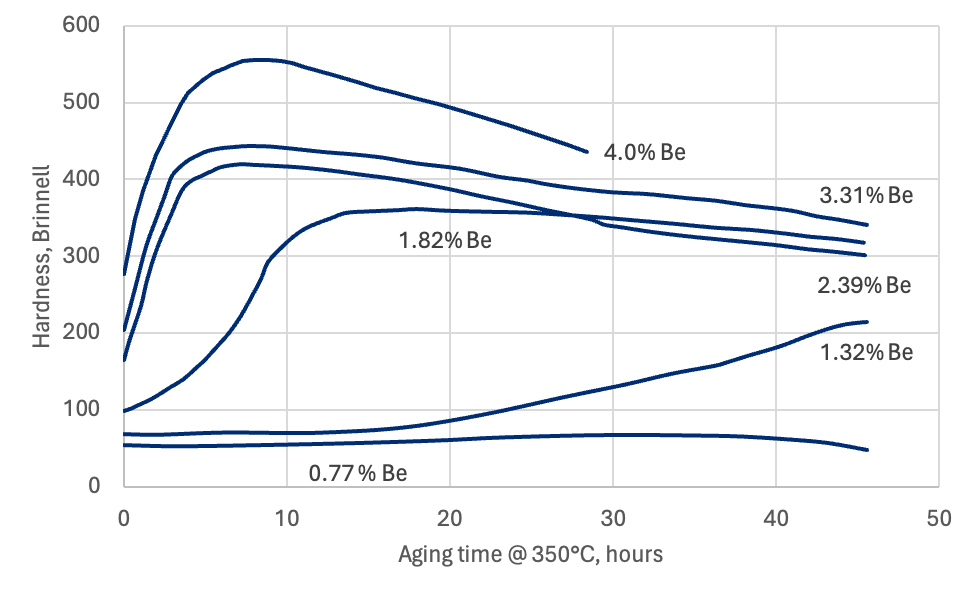
Figure 1 shows the aging curves of some Be-Cu alloys containing 0.77-4.0% Be. Alloys with 0.77% Be do not harden because of artificial aging. However, if the Be content is raised to 1.32%, a significant hardness increase occurs after aging for 16+ hours. As the Be content is raised, the ultimate hardness is increased, at shorter aging times.
Looking at the supersaturated solid solution hardness, (t = 0), it can be observed that the hardness increases as the Be content is increased. This is because of solid solution hardening of the matrix. The face-centered cubic copper matrix must accommodate the smaller atomic radius of beryllium [7]. This results in strains in the matrix, increasing the hardness of the matrix.
At concentrations greater than approximately 2.7% Be, dispersion hardening occurs. This is due to undissolved β phase. The undissolved β phase is harder than the matrix, resulting in increased hardness.
This means that not only is the hardness of the alloy dependent on traditional artificial aging — strengthened through the precipitation of coherent and slightly incoherent precipitates — but also on solid hardening, and dispersion hardening.
Health and Safety
Bulk Be–Cu products pose relatively low exposure risk in normal service; however, beryllium is a regulated toxic element, and dusts or fumes generated during processing (machining, grinding, high‑temperature operations) require stringent controls. Heat-treatment operations should be configured to minimize oxidation and scale formation that could later become airborne dust during handling or finishing [3]. Cleaning of furnace interiors, quench tanks, and salt baths must be carried out in a manner that avoids generating respirable Be‑bearing particulates. Proper personal protective equipment (PPE) and personnel training is essential.
Conclusion
In this article, we covered the heat treatment of Be-Cu alloys. This alloy system follows the classical artificial aging sequence like aluminum alloys, with additional complexities of solid solution hardening and dispersion hardening.
As always, should there be any questions regarding this article, or suggestions for additional articles, please contact the editor or me.
References
- G. Whiteman, J. Millett, M. Broadbent, N. Park and P. Hazell, “Investigation of the Role of Age Hardening on the One-Dimensional Shock Response of Copper – 2wt.% Beryllium Alloys,” in 65º Congresso ABM, Rio de Janeiro, Brazil, 2010.
- A. H. Geisler, J. H. Mallery and F. E. Steigert, “On the Mechanism of Precipitation in Copper-Beryllium Alloys,” JOM, vol. 4, pp. 307-316, 1952.
- A. G. Guy, C. S. Barrett and R. F. Mehl, “Mechanism of Precipitation In Alloys Of Beryllium In Copper,” Trans. AIME, no. February, pp. 216-238, 1948.
- H. E. Boyer, “Heat Treating of Nonferrous Alloys,” Metallogr. Microstruct. Anal., vol. 2, pp. 190-195, 2013.
- J. E. Hatch, Aluminum: Properties and Physical Metallurgy, Metals Park, OH: American Society for Metals, 1984.
- J. Britton and B. L. Daniell, “Heat treatment of beryllium-copper alloys”. United Kingdom Patent GB1268871A, 13 January 1970.
- National Center for Biotechnology Information, “Atomic Radius in the Periodic Table of Elements,” PubChem, 2026.