









This month, I will be discussing the physical metallurgy of the precipitation hardening beryllium-copper alloys, used in a variety of unique applications such as non-sparking tools and electrical connectors.
Introduction
Beryllium-copper alloys are unique in that they can be used for applications requiring high electrical conductivity and high strength. The most common uses of Be-Cu are in electrical applications, such as connectors, terminals, sockets, spring contacts, and switch blades. These applications require the high strength, excellent electrical conductivity, and fatigue properties to prevent failure during repeated use. By properly balancing the heat treatment, the optimum electrical conductivity and mechanical properties can be achieved.
Be-Cu is also used in non-sparking tools and safety-related hardware for hazardous environments. Because the alloy does not produce sparks easily on impact, it is selected for oil-and-gas facilities, chemical plants, mining operations, and explosive atmospheres. In those settings, the non-sparking characteristic can be more important than maximum strength.
Spring performance is one of the applications using Be-Cu. This is especially true if the springs require good electrical conductivity, such as flat springs, diaphragms, beam springs, bellows components, and small load-bearing elastic elements. The fine precipitate structure developed on aging gives a high elastic limit, so springs can be cycled many times without taking a permanent set.
The alloy is particularly effective where the spring must also serve as an electrical conductor or where dimensional precision is critical. In such cases, the aged structure provides both mechanical resilience and sufficient conductivity for functional integration. That combination is difficult to match with many other spring materials.
The most common wrought strengthening grades, such as C17200, contain roughly 1.8 to 2.0 wt% Be, while other wrought and cast grades vary in Be content and may also include Ni, Co, or Pb depending on conductivity, machinability, or casting requirements. These additions matter because they can shift precipitation kinetics, modify the sequence, and change the balance between strength and conductivity. In the base Be-Cu alloy, however, the same basic precipitation sequence governs hardening.
Beryllium-Copper Precipitation Sequence
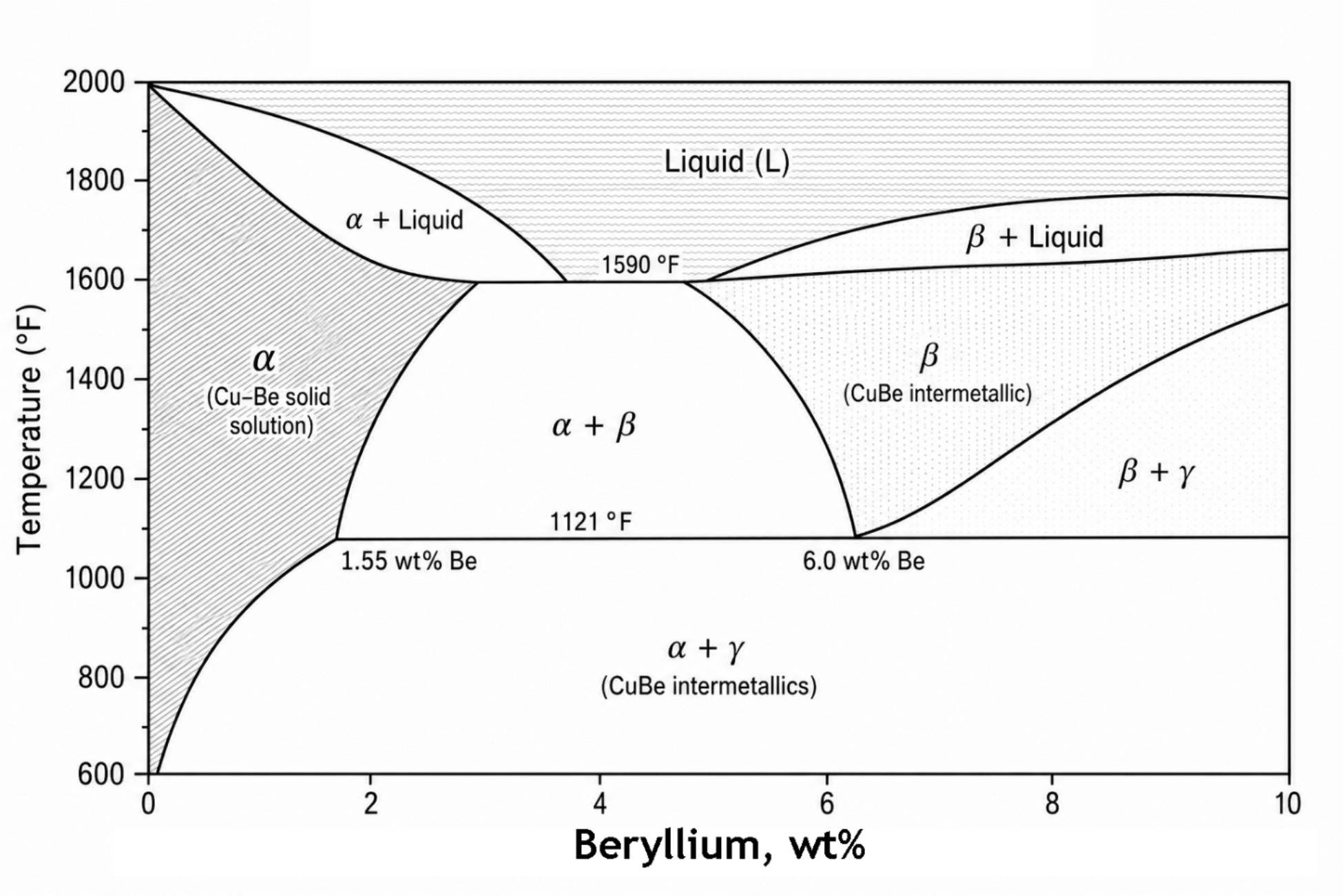
In many ways, the Be-Cu system can be compared to the Al-Cu system for precipitation heat treatment. As in the Al-Cu alloy system, there is decreasing solubility of beryllium in the copper alpha (α) phase with decreasing temperature. Since there is decreasing solubility as temperature decreases, this satisfies the basic criteria for precipitation hardening. This is seen in the copper rich end of the Be-Cu phase diagram (Figure 1).
At Be concentrations encountered in typical Be-Cu alloys (1.8-2.0%) the precipitation sequence is made more difficult by the beta phase, in the alpha + beta phase field, converting to gamma. However, the essential aging sequence is unchanged.
Beryllium-copper alloys are solution heat treated at approximately 1,500°C (815°C) to bring all the alloying elements into solution. Upon rapid quenching (typically water or polymer), a supersaturated solid solution of Be-α copper results. There is a large thermodynamic driving force for decomposition during aging because of the large solubility gap. It is this large solubility gap that is one reason why Be-Cu alloys can achieve high strengths relative to other copper alloys.
Initially, during aging, there is clustering of the Be atoms in the copper matrix. These very fine clusters form Guinier-Preston zones on {100} matrix planes[2] [3]. The GP zones act as precursors to later coherent precipitates that provide strengthening, and eventually the incoherent equilibrium precipitate.
The basic precipitation mechanism is supersaturated alpha-Cu after quench, GP clustering on {100}, metastable gamma double-prime, metastable gamma prime, then stable gamma equilibrium precipitate (Equation 1):

As in aluminum alloys, strengthening occurs before the formation of the equilibrium precipitate, and the onset of coarsening.
The gamma double-prime stage provides the largest amount of strengthening because it is extremely fine and coherent or nearly coherent with the face-centered cubic (FCC) α-Cu matrix. These γ” precipitates are extremely small and are observable only through the TEM. They are typically body-centered tetragonal in structure and usually appear as plates or disc-shaped precipitates.
The precipitates grow along the {100}α planes of the copper matrix. Coherency strains make dislocation motion difficult, so even a low volume fraction can produce a large increase in hardness and yield strength.
The gamma prime phase is a metastable semi-coherent phase that appears after gamma double-prime during aging. It occurs before the precipitation of the equilibrium gamma phase. The γ‘ phase has an ordered body-centered tetragonal (BCT) structure, which is a step closer to the equilibrium body-centered cubic (BCC) structure of the equilibrium precipitate.
The morphology of γ‘ is either later plate like precipitates, or acicular or needle shaped, compared to the disc-shaped γ“. Gamma prime is coherent on the {112}α or {112}α of the copper matrix [4]. While γ’ still contributes to the alloy’s strength, it typically corresponds to the onset of over-aging, as the γ‘ grows and consumes the γ” phase, the hardness begins to decrease.
The final equilibrium precipitate, CuBe is an ordered body-centered cubic (BCC) structure, and is an intermetallic, with a 1:1 ratio of copper to beryllium atoms. It is incoherent with the copper matrix.
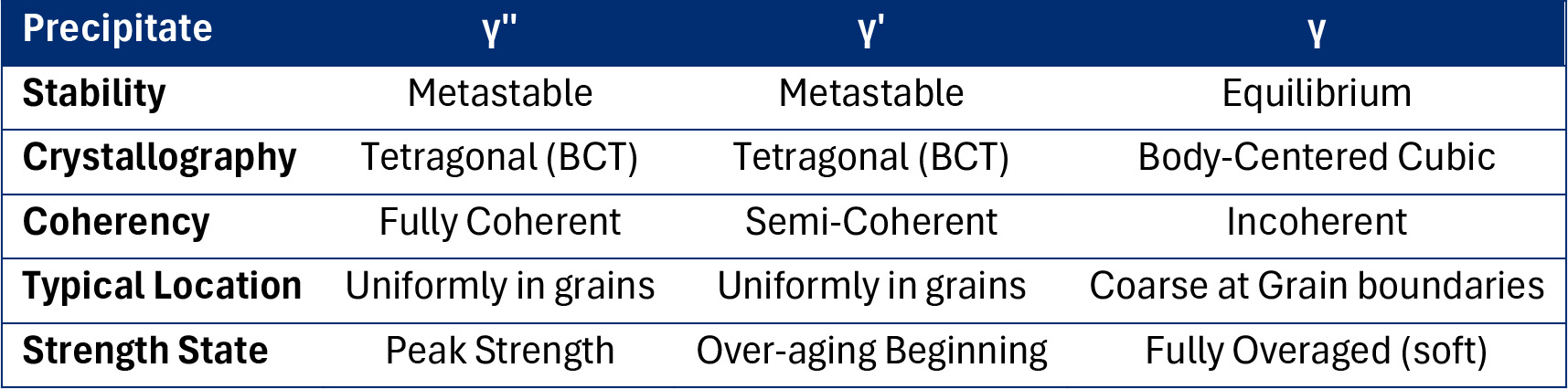
A summary of the precipitates is provided in Table 1.
Cold work before aging generally increases the rate and sometimes the magnitude of hardening. Plastic deformation raises the dislocation density, which provides heterogeneous nucleation sites and short-circuits diffusion paths. The result is often a faster approach to peak hardness and, in some cases, a higher peak because more precipitates can nucleate on the stored strain field [1] [2] [3].
Conclusion
In this article, the basic precipitation sequence of beryllium-copper alloys has been discussed. In a later column, the aspects of heat treatment of beryllium-copper alloys will be provided.
Should you have any questions or comments regarding this article, or suggestions for additional articles, please contact the editor or author.