









In this column, I will discuss the different types of titanium alloys and review their physical metallurgy.
Introduction
Titanium alloys are widely used in aerospace, chemical, and biomedical applications. They are increasingly used in automotive applications, because of the unique strength-to-weight ratio, chemical resistance, and heat resistance. The low creep rates at elevated temperatures make it an excellent alloy for turbine blades and discs in the low and intermediate stages of compressors.
Titanium is widely used for biomedical applications, such as bone and joint implants, as well as dental implants. This is due to the excellent corrosion resistance of titanium, and its biocompatibility.
Automotive applications include exhaust systems for exotic cars and titanium valves used by Toyota [1]. Titanium suspension components, and springs are used in motorcycles and racing cars. Titanium is also used in bicycle frames and sporting equipment.
Physical Metallurgy
Titanium has only two crystal structures: the low temperature structure, alpha (α) titanium, which is a close packed hexagonal structure (HCP), and beta (β) titanium, which has a body-centered-cubic (BCC) structure. Alpha titanium, in pure form, is stable from room temperature to about 882°C (1,620°F). After being heated to about 885°C, the alpha titanium transforms to beta titanium by allotropic transformation, which is stable up to the melting temperature of pure titanium (1,668°C or 3,034°F) [1].
Allotropic transformation is a reversible reaction, where the pure material changes its crystal structure at a specific temperature. This is like pure iron (ferrite or α-iron) at room temperature (body-centered-cubic or BCC) transforming to austenite (γ) with a face-centered-cubic (FCC) structure. Alloying element additions can change the temperature of the β-transus (temperature where α transforms to β). Alloying elements are classified as α stabilizers (Al, O, N, C, Sn, Zr) that raise the β transus and extend the stability field of hcp α, and β stabilizers (Mo, V, Nb, Ta, Fe, Cr, Mn, Ni, Cu) that lower the β transus and expand the bcc β field. It is the balance between the alloying elements that determines the microstructure.
Titanium alloys are conventionally divided into three main classes: alpha(α), alpha–beta (α + β), and beta (β), depending on the predominant phase present [2].
The behavior of these alloys is controlled by the allotropic αΔβ transformation of titanium and the division or partitioning of alloying elements between these phases.
The physical metallurgy and properties of these alloys is, in large part, governed by how alloying elements shift the β transus and change the α (hcp) or β (bcc) ratio [3].
Alpha Alloys
Alpha alloys at room temperature have a single-phase microstructure of HCP α, with a distribution of fine interstitial solutes (oxygen, nitrogen, and carbon) and substitutional elements (aluminum, tin and zirconium) that strengthen the matrix by solid solution [4].
Aluminum is a primary substitutional α stabilizer. It contributes significantly to strength but can reduce ductility and creep resistance if the aluminum content is too high. Aluminum content is generally limited to approximately 7 percent to prevent the precipitation of Ti3Al, which can lead to severe embrittlement [5]. Sn and Zr further strengthen α and improve creep resistance through size misfit and stacking‑fault energy effects.
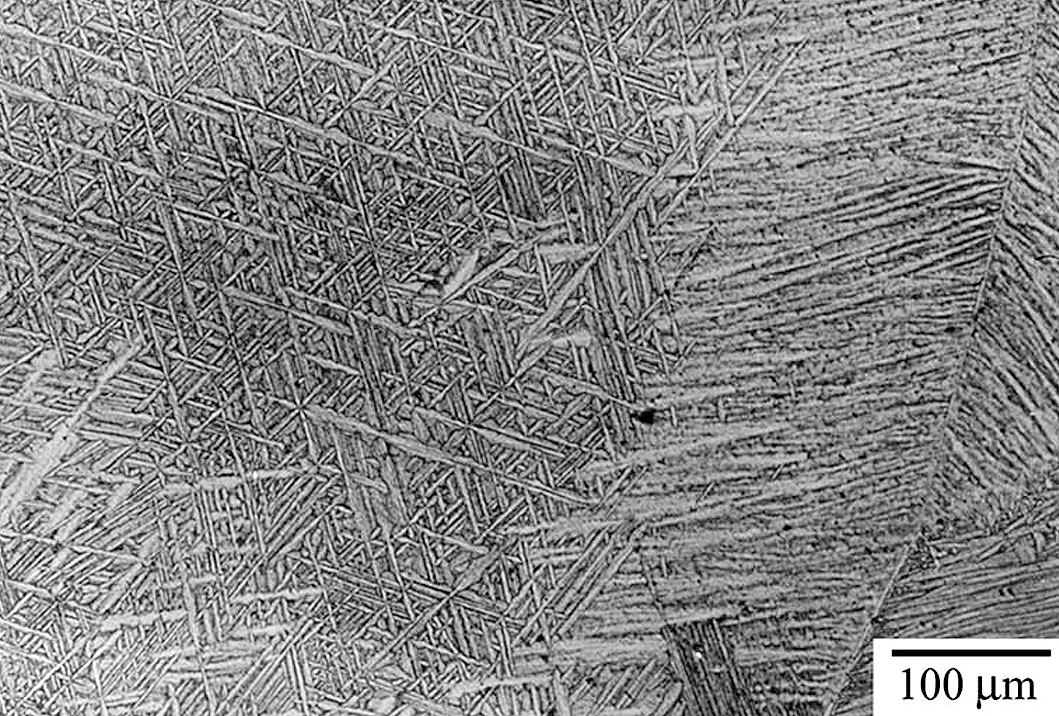
Alpha alloys only have three different microstructures. The first equiaxed alpha, which is the result of recrystallization after deformation and heating. The second microstructure is Widmanstätten alpha, which occurs as the alloy is cooled moderately slowly from above the β-transus (Figure 1). This is the familiar “basket-weave” pattern and microstructure. Lastly, there is martensitic alpha (α’) which forms upon rapid cooling from above the β-transus.
Alpha-Beta Alloys
These α–β alloys contain sufficient β stabilizers (V, Mo, Fe, Cr, etc.) that both phases are present at room temperature over a useful compositional range. The prototypical alloy is Ti–6Al–4V, which contains roughly 6 wt.% Al as α stabilizer and 4 wt.% V as β stabilizer.
In these alloys, the primary transformation path involves β decomposing to α+β upon cooling. Different microstructures can result, depending on the cooling rate and composition. At moderate cooling rates (such as air cool from the β field), Widmanstätten or basketweave α plates can nucleate on prior β grain boundaries and grow inward, with retained β located between the α plates. At higher cooling rates, a martensitic transformation can occur, resulting in the hexagonal α’. This martensite is supersaturated with alloying elements and decomposes on subsequent aging into fine α+β mixtures, greatly strengthening the alloy [4] [3] [1] [5].
Beta and Metastable-Beta Alloys
In these alloys, the physical metallurgy is controlled by precipitation reactions from supersaturated β [6] [7] present at room temperature. These alloys are predominantly composed of β stabilizers such as vanadium and molybdenum, with limited α stabilizers. These alloys give up mechanical strength to improve ductility. Because of the very high concentration of β stabilizers, even air cooling is sufficient to retain β in a metastable or stable condition [3].
In metastable β alloys, containing 10-15 percent of β stabilizers, β is metastable at room temperature. This metastable phase can be aged to produce a very fine Widmanstätten α in a β matrix. Aging the metastable structure in the range of 425–600°C produces fine, coherent, or semi‑coherent α precipitates within β, such as the precipitation hardening in aluminum alloys [8]. As aging progresses, α coarsens and strength falls while ductility improves. These alloys have an excellent balance of high strength, toughness, and ductility over a wide range of temperatures.
If very large additions of β stabilizers are present (30+%), then β is stable at room temperature. These alloys exhibit poor ductility [1] and are used for highly specialized corrosion resistance applications [6].
Conclusion
Titanium alloys are used in a wide variety of applications ranging from aerospace and biomedical, to automotive and sporting equipment. These applications require an excellent strength and a high strength-to-weight ratio. By controlling the alloying composition, the temperature of the β transus can be controlled, yielding the three different types of titanium alloys. Should you have any comments on this article, or suggestions for further articles, please contact the editor or the author.
References
- V. A. Joshi, Titanium Alloys: An Atlas of Structures and Fracture Features, Boca Raton FL: CRC Press, 2006.
- J. Barksdale, “Titanium,” in The Encyclopedia of the Chemical Elements, C. A. Hampel, Ed., New York, NY: Reinhold Book Corporation, 1968, pp. 732-738.
- F. F. Schmidt and R. A. Wood, “Heat Treatment of Titanium and Titanium Alloys,” NASA, Huntsville, AL, 1966.
- E. Marin and A. Lanzutti, “Biomedical Applications of Titanium Alloys: A Comprehensive Review,” Materials (Basel), vol. 14, no. 1, p. 114, 2023.
- I. Weiss and S. I. Semiatin, “Thermomechanical Processing of Alpha Titanium Alloys—An Overview,” Mater. Sci. Eng. A Struct. Mater., vol. 263, pp. 243-256, 1999.
- F. H. Froes, Ed., Titanium Physical Metallurgy, Processing and Applications, Materials Park, OH: ASM International, 2015.
- C. Leyens and M. Peters, Eds., Titanium and Titanium Alloys, Weinheim: Wiley-VCH Verlag GmbH, 2003.
- B. Minhalina, L. Toth, P. Pinke and A. T. Kovacs, “Heat Treating Processes of Titanium Alloys,” Műszaki Tudományos Közlemények, vol. 21, pp. 56-60, 2024.