






In this column, I will discuss martempering, and when it should be selected for quenching steel parts.
Normal Quenching and Martempering
The most common method of hardening steel in industry today consists of heating the steel component to the austenitizing temperature, quenching in a suitable quenchant, and tempering to the desired hardness. This is shown schematically in Figure 1 [1].
In this example, the part is austenitized and then quenched in a quenchant fast enough that the surface and center of the part miss the “nose” of the TTT curve and are completely through hardened. The slowest possible quench to achieve through hardening corresponds to the quench rate enough to just miss the “nose” of the TTT curve. Slower quench rates than the minimum will result in the formation of non-martensitic transformation products of ferrite, pearlite, and bainite. It should be noted that the TTT curve has no bearing on the tempering reaction.
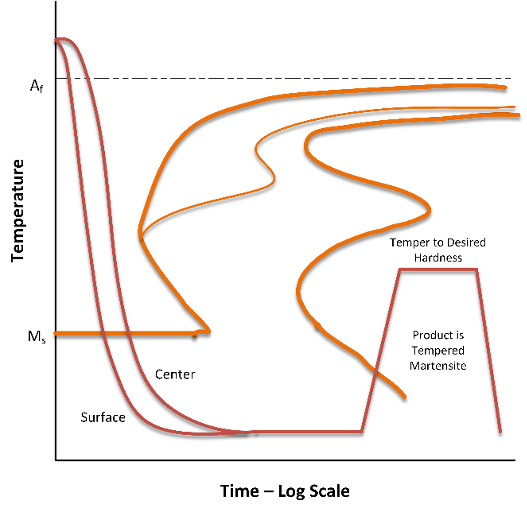
For most applications, the austenitizing temperature is approximately 25-30°C above the Ac3 temperature. After properly soaking at temperature, the part is then quenched rapidly into brine, water, polymer, or oil. The quenchant is generally less than 80°C for oil, and at ambient temperature for the water-based quenchants (water, brine, and polymer). This rapid quenching ensures that the part meets hardness requirements but also creates a steep temperature gradient between the surface and the core. The result can be higher internal stress, more warpage, and a greater risk of quench cracking, especially in parts with abrupt section changes or tight tolerances
Martempering is a specialized process that should only be used when distortion and high residual stress are an issue. In this process, parts are quenched from the austenitizing temperature into hot oil or molten salt at the approximate martensite start temperature (100-200°C). The part is held at the oil temperature until the surface and center temperatures of the part are nearly the same. Once the center of the part has reached the quenchant temperature, the part is removed from the quenchant and allowed to cool in any convenient manner (usually air cooling). This minimizes the formation of thermal stresses due to unequal cooling between the center and surface (Figure 2) [1]. It also reduces the transformation stresses due to martensite transformation occurring at different times.
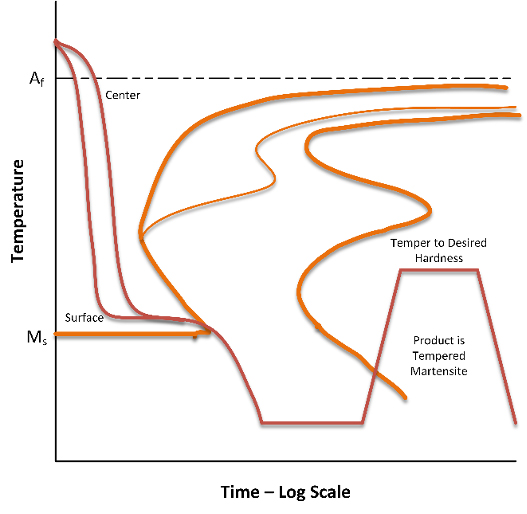
If complete hardening is to occur, the austenite must cool sufficiently fast to allow the center cooling rate to miss the “nose” of the TTT diagram. Since the TTT diagram shows the martensite start temperature, Ms, the TTT diagram is useful for selecting the optimal quenchant temperature and estimating the time the part must be held at temperature to prevent the formation of bainite.
Martempering makes the most sense when distortion control, crack avoidance, and dimensional consistency matter more than minimizing processing cost. It is especially valuable for parts with complex geometry, changing cross sections, tight tolerances, or expensive machining that would make rework costly [2].
The main advantage of martempering is that it interrupts the steep surface-to-core temperature differences that drive distortion. In direct quenching, the surface cools and transforms first while the core remains hot, creating a mismatch in contraction and transformation strain. Martempering gives the section time to come closer to a uniform temperature before the martensitic transformation begins, which reduces internal stress and makes the final shape more predictable.
That benefit is most useful when the part has a high penalty for dimensional change. Gears, shafts, tooling, dies, bearings, and other precision components are common candidates because even small distortion can create costly downstream problems. Martempering is also useful for carburized parts, where the carbon-rich case and lower-carbon core respond differently during quenching and can magnify distortion if the quench is too severe.
When is Martempering Appropriate?
Martempering makes sense to use if the cost of distortion and rework is higher than the cost of the heat-treating process itself. Long, slender shafts, gears, tooling, bearing rings and rollers, precision mechanical parts, and components with abrupt changes in section often benefit the most. These parts tend to show the greatest amount of distortion, and the cost of rework (or replacement when cracking occurs) is high.
One criterion for the applicability of martempering is the tendency of a part to crack or distort. This is based on the carbon equivalent, or CE. The carbon equivalent is calculated in Equation 1 [6, 4, 1]:

Where concentrations are given in weight percent. In each case, quenching cracking was determined to be a problem if the carbon equivalent (CE) > 0.52%. If the carbon equivalent of the steel is greater than 0.50%, then the steel is a good candidate for martempering.
The limitations of section thickness must also be considered for suitability for martempering. With a given severity of quench, there is a limit in section thickness, where the steel will no longer harden fully or transform to martensite. However, depending on the application, it may be acceptable for the center of the part not to be completely transformed to martensite.
Often it is acceptable that the core hardness is less than the surface hardness. If this is the case, then the size for martempering can be increased. The effect of the resulting mixed microstructure on the mechanical properties would have to be evaluated for each application.
Martempering is not the best answer for every hardening problem. It usually costs more than conventional quenching because it requires tighter process control, additional hold time, and often specialized media such as hot oil or molten salt. If the part is simple, and is not prone to distortion or cracking, the added cost of martempering may not be justified.
Conclusion
Martempering is a viable technique for reducing distortion and minimizing residual stresses in heat-treated parts. However, it is more expensive on a per part basis than traditional quench and temper operations. Martempering should be used when the cost of rework is more expensive than the cost of the process itself.
Should there be any comments or questions regarding this article, please contact the editor or myself.
References
- D. S. MacKenzie, “Understanding the different types of heat treating,” Gear Solutions, February, pp. 24-26, 2019.
- G. Krauss, Steels – Processing, Structure, and Performance, 2nd ed., Metals Park, OH: ASM International, 2015.
- T. Kasuya and Y. Hashiba, “Carbon Equivalent to Assess Hardenability of Steel and Prediction of HAZ Hardness Distribution,” Nippon Steel, 2007.
- T. Kunitake and S. Susigawa, “Quench Cracking Susceptibility of Steel,” Sumitomo Search, pp. 16-25, May 1971.
- K. Lorenz and C. Duren, “Evaluation of large diameter pipe steel weldability by means of carbon equivalent,” in Proc. Int. Conf. Steels for Line Pipe and Pipeline Fittings, London, 1981.
- G. Krauss, “Microstructure, Residual Stresses and Fatigue of Carburized Steels,” in Proc. 3rd IFHTSE and IMM International Seminar on Quenching and Carburizing , 1991.