




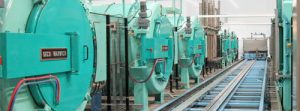

Superalloys are used in a wide variety of applications that require oxidation resistance, high temperature creep resistance, and strength at elevated temperature. They are found in jet engines and turbine applications.
Introduction
Superalloys are high‑performance metallic materials engineered to retain strength, resist creep, and withstand oxidation and corrosion at temperatures where most alloys would rapidly fail. They are indispensable in gas turbines, jet engines, nuclear systems, and other extreme environments where reliability at high temperature is critical [1].
Superalloys are generally defined as alloys that maintain excellent mechanical properties, oxidation resistance, and corrosion resistance at temperatures typically above about 0.6 of their absolute melting temperature. They are often called high-performance alloys and are usually based on nickel, cobalt, or iron, with additional alloying elements such as chromium, aluminum, titanium, molybdenum, tungsten, niobium, and others to tune microstructure and performance.
These alloys have been specifically developed for high strength at elevated temperatures above 600°, where resistance to oxidation is required [2].
Nickel-Based Superalloys
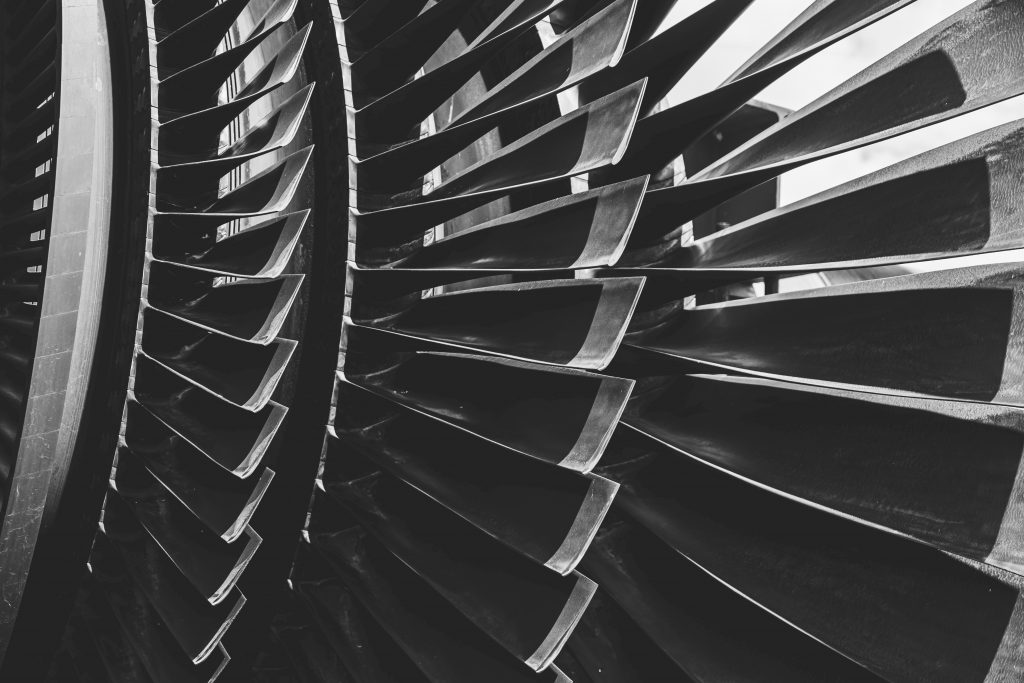
Nickel-based superalloys are the largest class of superalloys due to excellent high-temperature strength and oxidation resistance. They are most often used in the hottest sections of gas turbines, and include the turbine blades, vanes, and hubs. These are applications where the temperatures can approach 1,100°C.
The earliest superalloys were based on a composition of 80Ni-20Cr, with minor additions of titanium and aluminum [3]. These alloys worked because of the formation of fine γ’ precipitates. However, due to limitations in microscopy, this precipitation was not discovered until the 1940s [3].
Gamma prime (γ’) has the composition of Ni3(Al,Ti) and has an ordered FCC structure (LI2). This phase is an intermetallic, and is coherent with the matrix (γ), and provides needed ductility [4]. This precipitate appears as very fine spheres, or as the precipitates grow, the morphology changes from spheres to cubes or plates, depending on the size of the matrix/precipitate lattice mismatch [3].
With the addition of niobium (Nb), another strengthening phase is formed — gamma double prime (γ’’). This precipitate is coherent with γ’, but dissolves at temperatures above 650°C. It is an ordered body-centered tetragonal structure with a DO22 structure. Nickel superalloys are produced in wrought and cast forms, with advanced turbine blades often fabricated as directionally solidified or single‑crystal components. Wrought age‑hardenable alloys are typically vacuum‑melted and thermos-mechanically processed, then solution treated and aged to precipitate γ’ or γ″. Cast and single‑crystal alloys are engineered to minimize grain boundaries and control solidification segregation, improving creep life and fatigue resistance in the blade environment.
Cobalt-Based Super Alloys
Cobalt-based superalloys exhibit excellent hot-corrosion and oxidation resistance due to a high chromium content [5]. Their thermal fatigue resistance and creep strength can exceed nickel-based superalloys [5].
Cobalt-based superalloys rely on solid solution strengthening and carbide precipitation for strength. This is different from nickel-based superalloys, which rely on a precipitation-strengthening mechanism.
The primary solid solution-strengthening elements used in cobalt superalloys are chromium, molybdenum, tungsten, columbium, and tantalum. These solid solution alloying elements are also strong carbide formers. These alloys provide a stable face-centered-cubic (FCC) matrix over a wide range of temperatures [1] [3].
Recently, Stato et al [5] discovered that some compositions of cobalt-based superalloys can be strengthened by a γ’ precipitation mechanism. In this case, the γ’ also had an LI2 structure, with the composition of Co3(Al,W). These alloys exhibited higher temperature strength than those of conventional nickel-based super alloys.
Iron-Based Superalloys
Iron-based superalloys are often used to reduce costs, as they are significantly less expensive than either nickel- or cobalt-based superalloys.
These iron-based superalloys are based on the ternary Fe-Ni-Cr, and can be either austenitic (at least 25% Ni face-centered-cubic) or ferritic (body-centered-cubic), depending on composition. For austenitic and ferritic iron-based superalloys, the strengthening mechanism is predominantly through the precipitation of order intermetallics, such as γ’ with compositions Ni3Al, or Ni3Ti. Further strengthening of the ferric grades is accomplished by five Laves-type phases dispersed in the matrix.
Iron-based superalloys are used in applications where nickel or cobalt based superalloys would be too expensive. Applications for Iron-based superalloys are often found in the chemical and petrochemical industry, where high resistance to chemical attack is needed in high-temperature environments. These alloys are often used in automotive applications.
Conclusions
This article provided an overview of the basic strengthening mechanisms in the three classes of superalloys, namely iron-, nickel-, and cobalt-based superalloys.
Should you have any comments or questions regarding this article, or have suggestions for further articles, please contact the writer or editor.
References
- A. Kracke, “Superalloys, the most Sucessful Alloy System of Modern Times – Past, Present and Future,” in 7th Int. Sym. on Superalloy 718 and Derivatives, Pittsburgh, PA, 10-13 Oct, 2010.
- B. M. a. C. I. Center, Handbook of International Alloy Compositions and Designations, Vols. II – Superalloys, Columbus, OH: Battelle Laboratories, Dec. 1978.
- C. T. Sims, “A History of Superalloy Metallurgy for Superalloy Metallurgists,” in 5th Int. Sym. Superalloys, Oct 7-11, , Champion, PA, 1984.
- R. Bowman, “Superalloys: A Primer and History,” 2000. [Online]. Available: https://www.tms.org/meetings/specialty/superalloys2000/superalloyshistory.html. [Accessed 14 January 2026].
- J. Sato, T. Omori, K. Oikawa, I. Ohnuma, R. Kainuma and K. Ishida, “Cobalt-Base High-Temperature Alloys,” Science, vol. 312, no. 5770, pp. 90-91, 2006.
- P. A. Ferreiros, P. R. Alonso and G. H. Rubiolo, “Coarsening process and precipitation hardening in Fe2AlV-strengthened ferritic Fe76Al12V12 alloy,” Materials Science and Engineering: A, vol. 684, pp. 394-405, 2017.