






Gears are among the most critical and geometrically complex components in modern mechanical systems. Their performance depends not only on precise geometry but also on the precise machining of distortions caused by microstructural transformations and thermal strain that occurs during heat treatment. For decades, manufacturers have relied on physical inspection after hardening to assess how heat treatment altered the gear. However, such measurements are often costly, time-consuming, and difficult to relate to predictive simulations.
A new integrated approach developed by DANTE Solutions, Inc. and Rochester Institute of Technology demonstrates how digital tools can simulate, measure, and even “virtually inspect” a heat-treated gear before it ever enters a furnace. Presented in “Integrated Heat-Treatment Simulation with Virtual Inspection of Distorted Gears” [1] at the 2023 ASM Heat Treating Society Conference, the study outlines how combining the DANTE heat-treatment simulation software with Integrated Gear Design (IGD) allows engineers to bridge the divide between thermal–mechanical modeling and shop-floor inspection. By merging simulation results with virtual metrology tools, engineers can predict distortion and evaluate common inspection metrics such as slope profile deviation, distance over balls, and base tangent length directly within the digital model. This integrated workflow effectively turns the heat-treatment simulation into a full virtual inspection process.
The Challenge: Predicting Distortion in Gears
Gear design involves tight tolerances and a delicate balance of geometry, material properties, and processing parameters. Standards guide designers toward suitable dimensions, but the final heat treatment can introduce distortions that shift those dimensions out of spec. Simulation tools such as DANTE have long provided insight into the stress, phase transformation, and distortion that occur during processes such as carburizing and quenching. Yet these results can sometimes be difficult to translate into the same language as coordinate measurement machine (CMM) data or shop inspection charts.
While it’s easy to compare predicted changes in outer diameter or roundness, more subtle gear characteristics such as tooth thickness, slope profile deviation, and runout have been harder to visualize or quantify virtually. The challenge then remains making distortion results from heat treatment simulation measurable in the same terms as physical inspection.
The Tools: DANTE and IGD
DANTE (Distortion ANalysis for Thermal Engineers) is a multiphase material modeling system that interfaces with major finite element solvers such as ABAQUS and ANSYS. It simulates heat-treatment processes in steels, aluminums, and nickel alloys, predicting:
- Microstructural evolution (austenite, ferrite, pearlite, bainite, martensite).
- Residual stress and distortion.
- Carburization, nitriding, and precipitation effects.
- Final hardness and phase distributions.
DANTE models capture transformations and stresses at each stage of the thermal cycle and have been widely used for process optimization, distortion minimization, and failure analysis. In this study, the predicted distortion modeling result forms the input for virtual inspection in IGD.
Integrated Gear Design (IGD) is a computer program for gear design and simulation co-developed by RIT and the Polytechnic University of Cartagena. It can generate gear geometries from manufacturing parameters, apply microgeometry modifications, perform tooth contact and finite element analysis, and automate virtual inspection of distorted geometries. IGD’s standout feature is its ability to build finite element models directly compatible with DANTE. It can export meshes for heat-treatment simulation and, once the simulation is complete, import the distorted geometry back into the software. There, engineers can compare the as-heat-treated gear with the nominal or finished geometry using the same measurements that would be made in a metrology lab.
Case Study: Virtual Inspection of a Carburized Pinion Gear
A combined IGD/DANTE model of a pinion gear was developed to demonstrate an example method of virtual inspection, bridging the gap between simulation results and actual gear inspection measurements. The material used in this case study is SAE 10B22, with a chemical composition shown in Table 1.

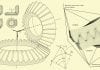
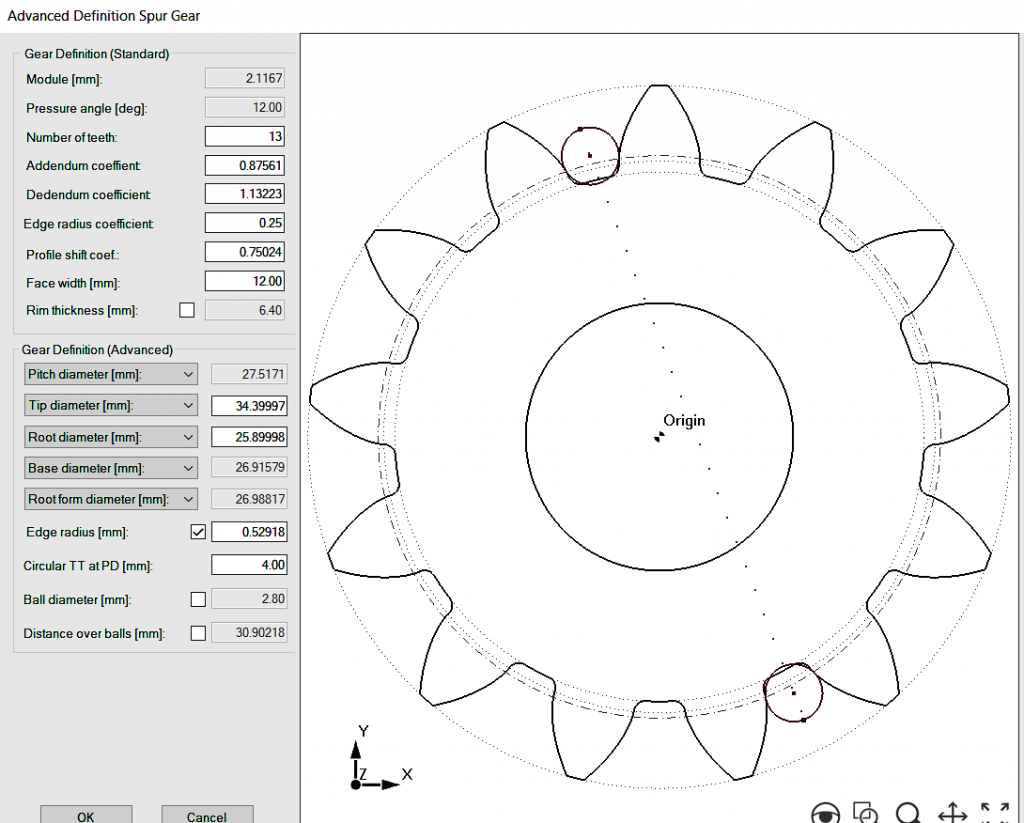
The heat-treatment process steps include gas carburizing, austenitizing, transferring to quench tank, oil quenching, and tempering. Using IGD, the pre-heat-treatment geometry is built from standard parameters such as number of teeth, diametral pitch, and base, form, and root base diameters, shown in Figure 1.
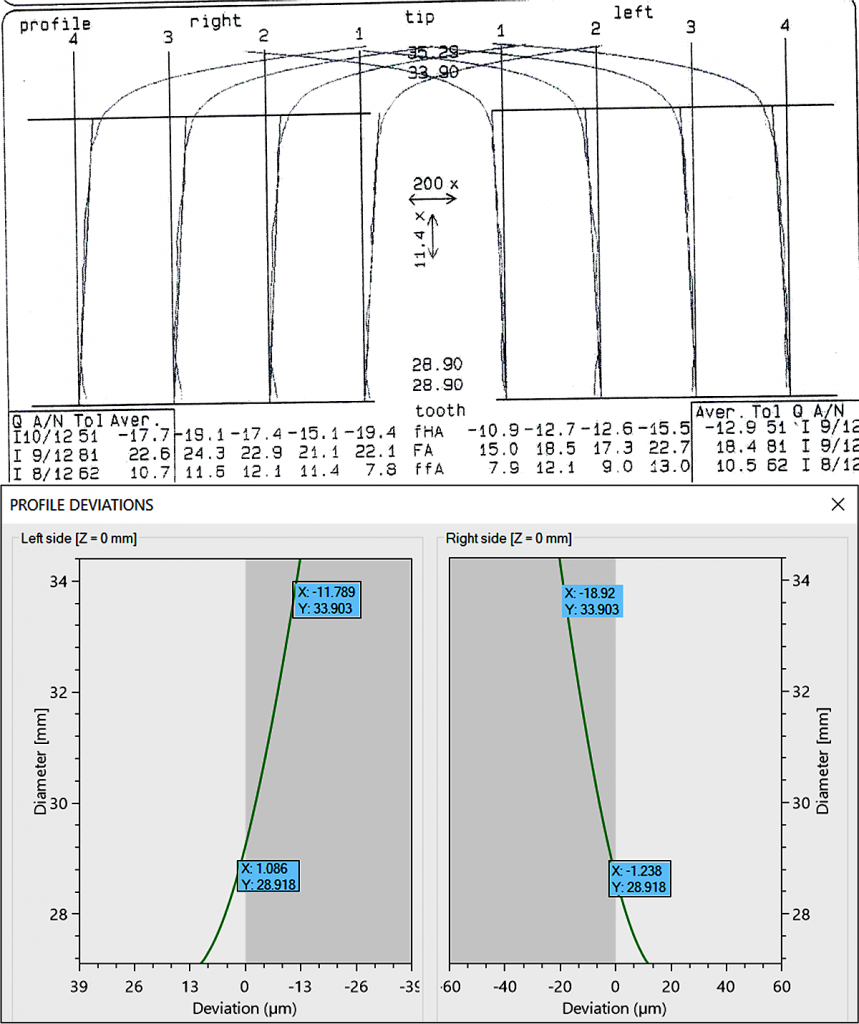
Variations in the tooth surface that influence gear noise and transmission error were also measured on four teeth and input into the pre-heat-treatment model. Figure 2 shows the measured profile deviations (fHA) with the IGD profile definitions defined; the right flank averaged 17.7 µm and the left 12.9 µm, with about a 5 µm range on each side.
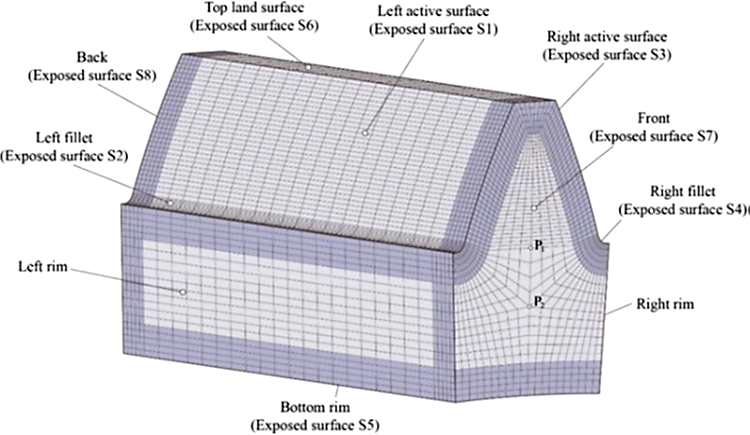
IGD enables users to define these deviations directly over the gear profile, which is challenging to perform directly in most CAD platforms. Incorporating these small geometric variations before simulation ensures that the virtual twin accurately reflects real manufacturing conditions. With the gear parameters and slope definitions defined, the FEA mesh is developed for the heat-treatment model. Figure 3 illustrates IGD’s mesh setup interface, where the user defines elements across the face width and tooth profile. The generated mesh and exposed surfaces are exported into an ABAQUS input format, forming the finite element model used by DANTE for thermal–mechanical simulation. The mesh in the heat-treatment model was developed with finer elements near the part surface to capture the steep thermal, chemical, and phase transformation gradients present in the heat-treatment process. The developed geometry is brought into ABAQUS and the material properties and boundary conditions, thermal and chemical, are applied for the DANTE heat-treatment model.
Simulation Results
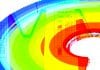
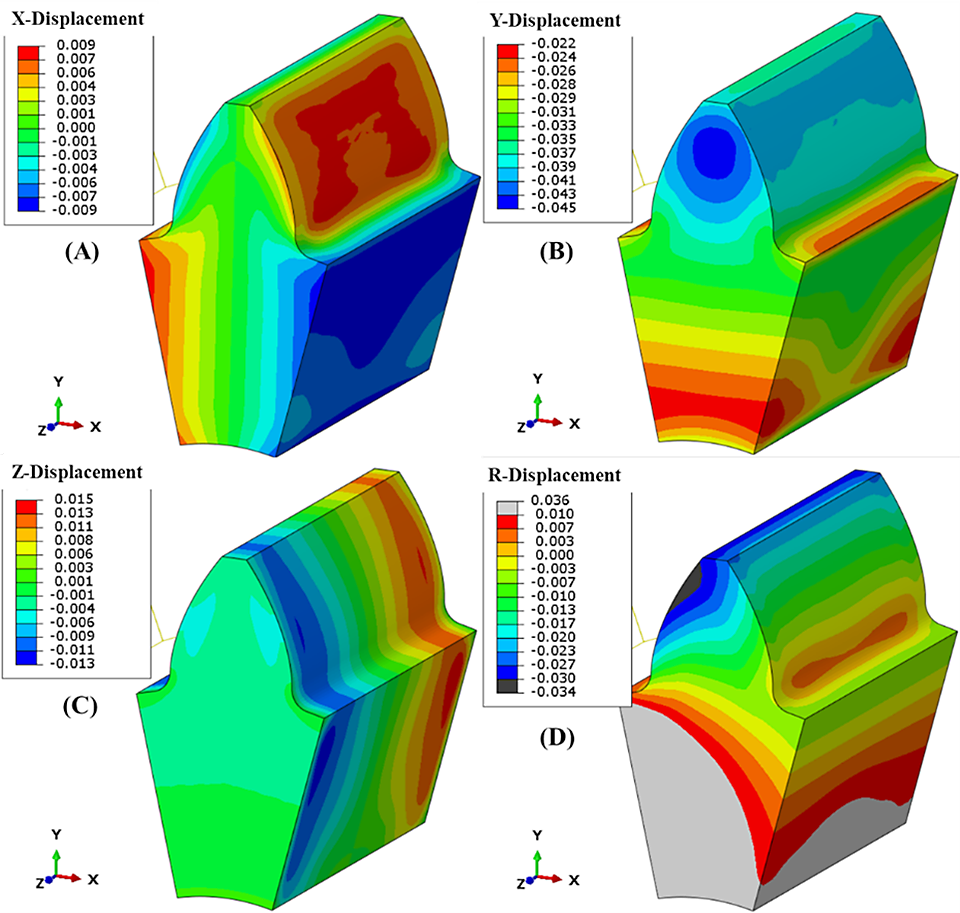
The DANTE model predicts several common heat-treatment results including hardness, carbon profile, phase composition, residual stress, and distortion. While hardness and stress predictions align naturally with laboratory data, distortion has been harder to validate in the same manner as a CMM would measure. The method of integrating IGD and DANTE allows the 3D displacement results to be directly compared to the measurable inspection data. Figure 4 shows DANTE’s displacement predictions along the X (a), Y (b), and Z (c) axes, while Figure 4 (d) transforms these into radial coordinates. The nodes on the flank surface can be directly plotted for comparison of the flank deviations, but this would need to be automated on a case-by-case basis, which is time/cost prohibitive.
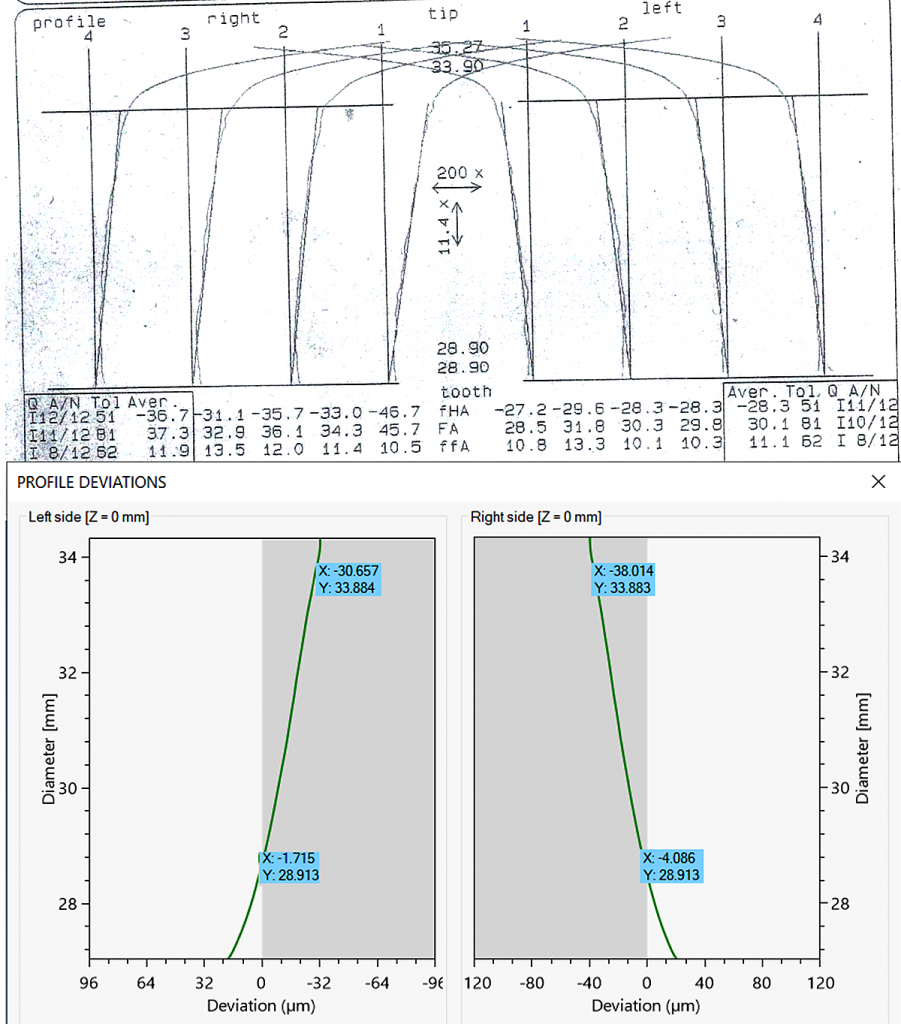
Using IGD’s built-in profile deviation tool, the post-heat-treatment model is read in, and the slope profile deviations are compared to the physical measurements, Figure 5. The simulation results agree well with the measured data:
Measured (after hardening):
- Right flank: 36.7 µm average (range ≈ 15 µm)
- Left flank: 28.3 µm average (range ≈ 3 µm)
- Predicted (simulation):
- Right flank: 33.9 µm
- Left flank: 28.9 µm
The virtual inspection successfully captured the direction and magnitude of distortion within experimental scatter, demonstrating the potential for quantitative process verification entirely within the virtual domain.
Conclusions
The integration of DANTE and IGD demonstrates a breakthrough in gear-process simulation. By combining DANTE’s heat treat predictions with IGD’s gear modeling and virtual inspection capabilities, a framework for complete digital evaluation of gears was shown. More inspection metrics can be used within IGD, such as the distance over balls, distance over pins, or the base tangent length. The ability to perform digital inspection using the same metrics as a CMM, directly from the simulation brings manufacturers one step closer to the digital twin ideal. As virtual tools grow more powerful, engineers may one day “measure” every heat-treated part before it ever leaves the computer. In that future, gear production will rely on virtual precision instead of costly trial and error.
Source
- Sims, J., & Fuentes-Aznar, A. (2023). Integrated Heat-Treatment Simulation with Virtual Inspection of Distorted Gears. Proceedings of the 32nd ASM Heat Treating Society Conference, Detroit, MI, USA