




Experience and innovation are often two sides of the coin. For companies like Centorr Vacuum Industries, who design and create critical equipment that serves the nuclear and aerospace sectors, those two factors are essential.
Centorr’s core businesses center around higher temperature furnaces for precision applications, according to Centorr President and CEO William Nareski.
“Those applications include aerospace, defense, medical, and nuclear,” he said. “Our idea of good high vacuum is 10-7 Torr and maximum temperature is 3,200°C. All of our chambers are stainless steel construction — not carbon steel with an epoxy finish on it. All of our diffusion pump systems have water-cooled, refrigerated, or liquid-nitrogen-cooled cold baffles in addition to cold caps.”

Special applications
That includes special applications for the nuclear industry for annealing of zirconium or Inconel tubing, according to Nareski.
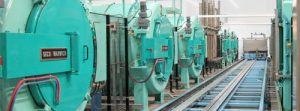
“We build tube annealing units that are between 10 meters and 30 meters in length because after Three Mile Island they found that previous materials didn’t have the properties needed for this application, and determined Inconel 690 to have much better resistance to corrosion and stress-corrosion cracking in high-temperature environments,” he said. “This required a new method of annealing using high-vacuum due to the higher Cr content.”
“We developed some of the first 30-meter-long vacuum furnaces, some of the largest in the world, and they include another 30-meter table to load them,” Nareski said. “We’ve done a series of these for Inconel 690 power water reactor tubing and 10-meter-long versions for zirconium tubing for the actual fuel rod application.”
That is just one example of how Centorr has used its expertise and innovation to solve complex challenges. With that in mind, Centorr supports laboratory and research development that ultimately leads to full production equipment, according to Nareski.
“We’ve got 65 different product lines; each one of those products is available in up to 15 or 20 different sizes,” he said. “We’ve got a number of standard products, but in the end, we’ll build whatever custom performance specification the customer needs. You get to pick exactly how you want it configured. As for our standard offering for precision heat treating, we make one product called the Workhorse, which is our refractory metal heat treating, annealing, sintering, and brazing unit.”
Extensive line of sintering options
Centorr has an extensive line of sintering furnaces that have a graphite hot zone and are used primarily for tungsten carbide sintering at about 1,600°C. They are also used for silicon carbide and ultra-high temperature ceramic sintering for graphitization applications and for carbon fiber composites boasting a temperature range of 2,200 to 2,800 degrees, according to Nareski.
“One of our key markets right now that we’re involved in is nuclear — whether it’s TRISO fuel or space fuel applications where we’re sintering uranium or plutonium with furnaces connected to glove boxes,” he said. “We are also actively in the hypersonics market selling chemical vapor infiltration furnaces that take carbon fiber composites and densify them through the introduction of propane, methane, and hydrogen gases for applications like aircraft brakes, and then take that carbon material and graphitize it at temperatures up to 2,900 to 3,000 degrees Celsius in production size furnaces.”

In addition to that, Centorr does lower temperature furnaces for precision brazing and heat treating as well, according to Nareski.
“We’ve got an application now for titanium in the firearms industry, and we’re making furnaces that heat treat 3D printed parts,” he said. “But because they’re titanium, they didn’t want a conventional heat treat unit with operation in the 10-5 Torr range. We’re able to give them an all-refractory metal hot zone design with moly and tungsten and take it up to 1,315°C (2,400°F) and get them in the 10-6 Torr range during processing, so they don’t have to worry about oxidation or discoloration.”
Custom design options
Centorr has been in continuous operation for more than 70 years, so the company has developed an extensive line of standard equipment; however, that doesn’t stop Centorr from developing and enhancing original products for the needs of any customer, according to Nareski.
“About 70 percent of the time, we’re building a standard, or we’re tweaking a standard,” he said. “But, 30 percent of the time, it’s an all-new design. We’re building one furnace right now for an aerospace client for a delicate low temperature heat-treating application where we are trying to replicate home-built units that are probably 30 or more years old. We’re using our nuclear tube annealing furnace design, shortening it, adding ultra-high vacuum pumps and coming up with an all-new design. That’s the fun part of the business — really starting from scratch.” With all its expertise, Centorr has positioned itself to offer accurate and state-of-the-art equipment with an exceptionally long productive life, according to Nareski.
“Our philosophy is to put out the highest quality vacuum and controlled atmosphere furnacing equipment and to target precision applications that require a robust trouble-free design,” he said. “We’re recognized for having extremely high-performance technology and equipment that lasts for decades in operation.
We’re busy replacing equipment in a nuclear application we built in the ’70s that is still utilized every week, and it’s now reaching end-of-life, and we’re looking at second generation equipment for those applications. Also, we embrace large scale furnace projects. Recently we completed a project, at the end of COVID, that amounted to $24 million in size.”
‘Keeping up with technology’
That ingenuity demonstrates how Centorr has moved with the changing technological landscape, according to Nareski.
“We’ve been very adept at keeping up with technology,” he said. “Our company is as deep in the engineering department as in our manufacturing group. The reason for that is because our designs are so highly specialized and custom developed.” As an example, Nareski emphasized how Centorr moved approximately 70 percent of the company’s controls strategy into a full PC/HMI design providing a better user experience with more elegant data logging and troubleshooting capabilities, as well as skid-mounting the equipment to make it more accessible to assemble and maintain. “One of the benefits there has been that you’re able to standardize and buy one type of control cabinet now for 10 different style furnaces because you’re not putting legacy mimic panels with switches and lights on the front of the cabinet; it’s now all on screen,” he said.
“Some new furnace designs are skid-mounted to a flat base; our customers are finding them easier to install and hook up onsite. You can simply pick up the entire unit with a load truck and drop them off in the plant. You connect air, water, power, and gas, and you’re up and running in a day or two. It’s been a benefit in-house as well because now you’re not taking it all apart and shipping it in five crates requiring four to five days to assemble it on site. It works out best for all parties.”
Working with customers
With the precision work Centorr does, it’s important to have a detailed relationship with each and every customer, according to Nareski.
“We’re your furnace guru,” he said with a laugh. “Come talk to us and confide in us your application details, and we’re going to ask you a lot of questions about your process — what material you’re running, what type of vacuum levels that you’re looking for — because we need to make sure that we select the right types of furnace design and individual components like vacuum pumping systems, as there are many different options to choose from.”

A potential customer may see a refractory metal hot zone and believe its preferred due to its cleanliness over graphite, and they want to produce tungsten carbide in it, not realizing that the carbon will react with the molybdenum refractory metal hot zones causing damage and short life expectancy, according to Nareski. “We like to think that we have enough process knowledge to help steer people in the right direction,” he said.
72 years of experience
Centorr is one of the oldest vacuum furnace manufacturers in the industry, having been founded in 1954, according to Nareski, but it continues to challenge itself while creating and improving new equipment for the industry.
“We’re growing our physical testing furnace offerings,” he said. “We make something called a Testorr®, which is designed for physical testing at elevated temperatures including tensile testing as well as 3- and 4-point MOR testing. That business has been very popular because of the importance of testing new hypersonic materials being used in outer space with re-entry temperatures in Mach 5 of 2,400 to 2,500°C and higher.
The equipment to do tensile testing on a piece of carbon composite that was used at those temperatures didn’t exist a decade ago. Now we’re developing 2,700°C lab furnaces that are used to support this effort.” As Centorr continues into the future, Nareski said that fields such as carbon fiber composites, hypersonics, and nuclear energy will become even more important. “The nuclear field is advancing with TRISO technology to supplement conventional fuel pellets and zirconium tubing with newer, safer designs with radioactive materials encapsulated in silicon carbide and pyrolytic graphite coatings,” he said.
“All of those materials are going to need to be processed in high-temperature vacuum and controlled atmosphere furnaces. The hypersonics market is going to be important, too, as there is really not a lot of high-temperature chemical vapor infiltration capacity out there, and we’re looking to help support that.” Centorr is celebrating its 72nd year as a high temperature vacuum and controlled atmosphere furnace manufacturer with an installed base of more than 7,000 units worldwide. Centorr’s bookings also remained strong in the first two quarters of 2026, giving it one of the strongest backlogs in the company’s history.
More info vacuum-furnaces.com