





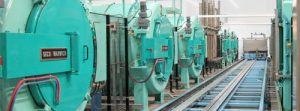
As industries need parts designed and heat treated to hyper-critical accuracies, it becomes the job of temperature controls and temperature sensors to ensure those design specifics are met.
For the OEMs of the world, Thermalogic Corporation has become one of the go-to manufacturers of accurate controls and sensors, and has been performing that function for more than 50 years.
“We’re not an off-the-shelf operation, so we can build things to exact specifications for people,” said Joe Grein, president of Thermalogic Corporation. “Most of the heat-treating people that we deal with are not like the furnaces and ovens and factories where you’re doing, say, 100,000 ball bearings a day. Most of the people we deal with are doing the remote heat treating as you’re building a bridge, for instance, going out and wrapping a 50-foot piece of metal and then heat treating it. We’re primarily focused on that.”

The OEMs that are Thermalogic’s heat-treating customers are buying portable units to use in the field, which work off generators, according to Grein.
“As an example, let’s say an OEM is building a bridge, and they need to test the metals to heat treat them before the assembly,” he said. “What the controllers will do is they will typically start at room temperature, wrap the blankets around the piece of metal or whatever they’re heat treating, and then ramp the temperature up from say room temp to 1,200 Fahrenheit over a specific period, which the customer can program. They can do whatever they want, because we build to order, so we configure it to exactly the way they want it. They might want to bring it up to 1,200 degrees over two hours, then bring it back down and bring it back to 1,200. The controller will take and retain that data, and they can print it out of the controller and specify this particular piece of metal has been heat treated, and here’s the document.”
Serving a variety of industries
Even though Thermalogic only serves OEMs, the company does business with a multitude of industries, according to Grein.
“As an example, over the years we’ve made all the controls for Pizza Hut ovens,” he said. “We do a lot of HVAC control for Amtrak and multiple transit authorities, because they want temperature controls for rolling stock that are very mill-spec oriented that are built exactly to their needs. We do a lot of these environmental control unit controls for the military, like the Army and the Marines. They set-up shop with these portable shelters, like a M*A*S*H tent. We pop them up and turn on the AC unit, and we make a lot of these controls that can work to minus-30 Fahrenheit, with an ambience up to 130.”
Thermalogic also does a lot of business in the medical sector, where super critical accuracy is needed. “We try to stay diverse, but we’re pretty much built to order,” he said.
‘Copy That’
To help keep that diversification going, Thermalogic recently introduced a campaign called “Copy That,” according to Grein.
“One of our big things is, over the years, we have been doing reverse engineering for OEMs,” he said. “Someone might have an old temperature control or temperature sensor and say, ‘We can’t get this anymore, or the vendor’s failing, or the price is quadrupled.’ So we say, send us one over, and we’ll copy that. That’s pretty much how we did most of the Amtrak business. They said, ‘We’ve been buying this unit since 1970. The vendor’s no longer in business.’ We’re engineering folk. We’re a manufacturer with engineering capability.”

Being able to turn on a dime and offer innovative solutions to its customers translates into Thermalogic’s base philosophy: Keeping the customer happy, according to Grein.
“We build to order what the customer wants — it’s really that simple,” he said. “And we’ll do anything. We like volume, but we’re not talking millions. Most of our clientele are low- to mid-volume. They might need 25 a year, maybe 500, maybe 1,000, it depends, but our philosophy is we build to order to the customer specs. We give a four-year warranty on our products, and I’m very emphatic about customer response.”
Product Platforms
To expedite a customer’s needs, Thermalogic has various product platforms, according to Grein.
“We have TempGuard, Micro TempGuard Analog, Master Series, DigiTherm, Temperature Sensors, HumiSense, and ShareSignal,” he said. “In essence, those are platforms that are a base. When someone comes to us for a custom design, they’re not like a guinea pig; we’re just reconfiguring something that’s already proven into their exact thing. They may want the board a certain size, different connectors, or they might need to be compatible to a specific place.”
Being able to offer customized equipment means that, as industries have evolved over the decades, so, too has Thermalogic, according to Grein.
“When we started, everything was little analog controls, knobs, and dials — which are still popular these days,” he said. “As time went on, people wanted digital displays, so we transferred to that, but there were analog digital displays where you still had to push a button and turn a knob. Then came the microprocessor era, where you could have more flexibility in the features. As time went on, that’s when we said we’re going to focus really on high-end custom. Some of our best accounts are people that want something exactly the way they want it. If it’s a computer interface, we could match their protocol. And we’re constantly evolving. Nowadays, the LED displays are starting to become less popular in the marketplace. Everyone’s going touchscreen.”

And now, some customers don’t even need a display, according to Grein.
“They might just want to monitor things and send it over Bluetooth, WiFi, Ethernet, or RS-232,” he said. “It seems like every day, something’s going obsolete, so we promise our customers form, fit, and function. We stay on top of issues like, ‘Hey, if this particular IC is going out of business, we have to replace it.’”
1971: The Beginning
Thermalogic began its 50-plus year journey in Waltham, Massachusetts, in 1971, according to Grein.
“My father, Lou Grein, and John DuBois were the founders,” he said. “My dad used to own another temperature control company, which he sold, so he ended up partnering up with John, and they decided that they were going to take a path on the OEM temperature control and temperature sensor market. We moved to Hudson, Massachusetts, in 1997 because in Waltham, we were at an old watch factory. Our company was on the first floor, the fourth floor, the second floor, and the basement, and we had to share a freight elevator. Later, we found a facility in Hudson, Massachusetts, that was able to accommodate our needs all on one floor with our own freight dock and everything.”

Grein believes the ability for Thermalogic to stay competitive will continue to remain strong as the company enters its next half-century of operation.
“There’s going to be a lot of hyper growth, but it’s going to stay fairly stable,” he said. “Because, in essence, temperature control is everywhere in the industrial market. It’s a limited market, and we’re pretty aggressive on the marketing.”
A large part of that is realizing that Thermalogic is, ultimately a relationship company, according to Grein.
“We help people determine their thermal aspects, thermodynamics — maybe sizing heaters or chiller capacities or cooling capacities or BTU amounts,” he said. “We’re not just out to sell you a product; we’re out to get you on board for life. If you run into issues outside of our product, we’ll work with you. We have even had customers send us their entire machines, and we troubleshoot them here in our factory or during engineering.”
More info: www.thermalogic.com