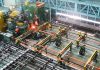






Direct heat treatment from forging, often called direct quench forging, direct-from-forge quenching, residual-heat quenching, or thermomechanical treatment plus quench, uses the forging’s retained heat as the austenitizing heat source. Instead of air-cooling the forging, reheating it to austenitize, then quenching and tempering, the part is transferred from its final forging operation directly to a controlled cooling or quenching operation.
Introduction
The basic principle of direct quench forging is simple — the process uses the residual heat from the forging process instead of cooling the part and reheating it for a conventional heat treatment. The process eliminates the secondary heating required for austenitization during conventional heat treatment. This can result in large energy savings and reduce the process steps required. A comparison of the two processes is shown in Figure 1.
For a direct-quench process, where the desired microstructure is martensitic, the part must cool rapidly enough to miss the ferrite, pearlite, and the upper-bainite transformation regions. If the cooling path passes through these transformations before reaching the martensite-start temperature, the resulting microstructure may be mixed, with non-uniform properties.
The process is typically billet heating, hot forging, trim/transfer, controlled quench, and temper. The quench may involve water, polymer, oil, high-velocity sprays, salt bath, or a sequence of these. A subsequent temper is normally essential for medium- and high-carbon martensitic steels because as-quenched martensite is brittle, highly stressed, and vulnerable to delayed cracking.
There are many different types of quenching, including austempering in a molten salt bath to produce a microstructure of bainite. The process used determines the final microstructure, so it is important to understand the desired properties and microstructure prior to final process determination.

Suitable Steel Alloys
Low- and medium-carbon alloy steels are generally the best choices for direct quench forging. They have the necessary hardenability without the severe cracking and distortion tendency of higher-carbon steels. Plain-carbon steels such as 1030, 1040, and 1045 can be directly quenched, particularly in small or moderate sections. However, because of their relatively low hardenability, this means that thick sections may develop ferrite-pearlite or bainite in the core even when the surface is martensitic.
Water quenching is generally required to harden these steels, but water quenching has the risk of distortion and cracking. This means that direct quenching of plain-carbon steel is normally most attractive for simple shapes, modest section thicknesses, and applications that tolerate a nonuniform hardness profile or use an intensive-but-controlled quench.
Boron-treated steels deserve special attention. Very small soluble boron additions can substantially improve hardenability by suppressing ferrite nucleation at austenite grain boundaries. This can permit lower-carbon steels to form martensite in sections that would otherwise need more carbon or more expensive alloy additions.
Chromium steels such as 5140 and 5160, as well as chromium–molybdenum grades such as 4130, 4140, 4145, and 4150, are among the most practical materials for direct quench forging.
The 41xx family provides a useful combination of hardenability, strength, and cost. SAE 4140 is frequently used for direct quench applications such as shafts, yokes, forged levers, and structural parts.
These grades often allow a polymer or oil quench rather than severe water quenching. However, due to their hardenability, these alloys are prone to distortion and cracking. Careful control of the quenching conditions will reduce residual stresses in the part.
Nickel-containing alloy steels such as 4340, 4330, 8630, 8640, and related grades have greater hardenability and often superior toughness potential in thicker sections. They are particularly useful where a direct quench must harden relatively thick sections or where low-temperature impact resistance is important.
Advantages
The largest advantage of direct quench from forging is energy reduction. The elimination of the secondary reheating cycle can result in very significant energy saving, as well as process time savings. The size of the cost reduction depends on the size of the part, production volume, and energy cost. One additional benefit is the potential reduction in carbon emissions, and reduction in carbon footprint. Decarburization and scaling are reduced because the steel is not subjected to additional heat- treating cycles. With high hardenability steels, such as SAE 4340, forging stresses can occur and can result in soft and hard spots. Further, residual stresses can cause issues with distortion. Since a reheating cycle is eliminated, some better distortion control can be achieved.
Limitations
One of the biggest problems with direct quenching from forging is the problem of grain growth. The high forging temperatures contribute to recovery and growth of the austenite grains, with prolonged times at temperature resulting in very large grains. Differences in grain size across the part can also occur due to differing degrees of deformation in the part. Areas with high deformation undergo dynamic recrystallization and grain refinement, while low-deformation areas retain coarse grains. This can cause issues with cracking and distortion. Conventional heat treatment typically refines the prior austenite grains through the transformation of pearlite and ferrite to austenite during secondary heating, improving toughness.
Forging is prone to temperature fluctuations for a variety of reasons, such as transfer times from the furnace to forge, die chilling, as well as part section thickness variation. Since the part is tied to the forging temperature, this can result in a non-homogeneous microstructure and properties. If machining is required, it can be difficult due to the end hardness of the direct quenched part.
Capital Constraints
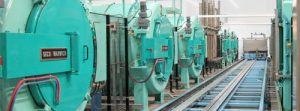
While there are large potential financial advantages to direct quenching from forging in the process, it requires significant up-front capital investment. This investment may include automated hot-part transfer, specialized quench equipment specifically for this part family, in-line temperature sensing and control, as well as tempering capacity.
The process also changes responsibility. The forge shop becomes responsible for critical heat-treatment outcomes that previously were the domain of the heat-treat shop. This requires much more process control than typical forging operations.
Conclusions
Direct quench forging is appropriate for steel forgings where the residual forging heat can be used to produce a controlled microstructure without sacrificing properties. The energy savings are significant, especially if large volumes of parts are required.
Direct quench forging is not a replacement for conventional heat treating. There are limitations on part size, alloy and microstructure.The process must consider the entire process chain to produce a part with the required microstructure and properties.